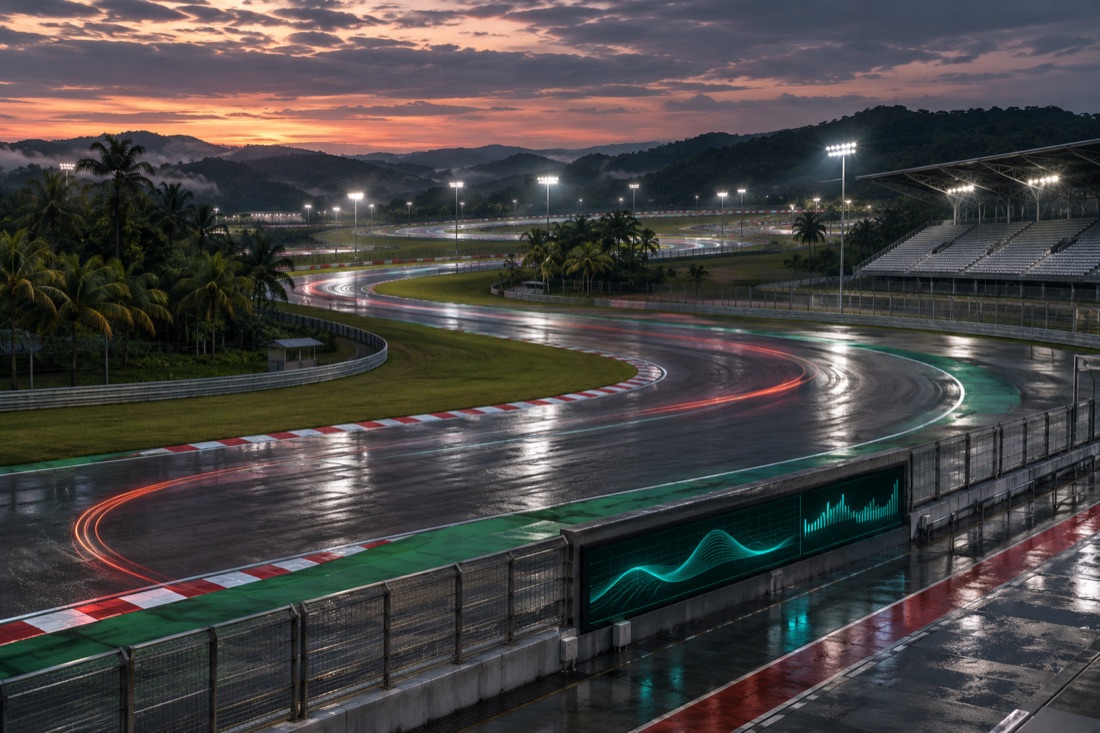
Race Circuits in Asia: F1 Tracks and Junior Venues
Race circuits in Asia range from Suzuka's figure of eight to the walls of the Macau Guia Circuit and the night lights of Marina Bay. This guide covers the F1 tracks in Asia, the venues where junior single-seaters race, and what makes each one difficult.
Which F1 tracks are located in Asia
Formula 1 has raced in Asia since the 1970s, and the continent now holds some of the best-known circuits on the calendar. In East and South East Asia, the current or recent F1 tracks in Asia include Suzuka in Japan, the Shanghai International Circuit in China and the Marina Bay Street Circuit in Singapore. Sepang in Malaysia hosted Formula 1 until 2017 and remains a major venue for other championships. Several circuits in the Middle East, which is also part of Asia, host Formula 1 as well.
These circuits matter for junior drivers too. National and regional single-seater championships use many of them, and a driver who learns Suzuka or Sepang in Formula 4 has a head start if they return in a faster car. The Formula 3 car explained page shows what kind of car runs there in the junior classes.
Suzuka, Japan
How long is the Suzuka Circuit? The full Grand Prix layout is 5.807 km, one of the longest tracks on the Formula 1 calendar, with 18 corners. Suzuka first hosted the Japanese Grand Prix in 1987. It is famous for its figure of eight shape, with the back straight passing over the front section of the track on a bridge, and for the fast sweeping corners of its first sector, which reward a car with good downforce and a driver with commitment.
For junior drivers, Suzuka is a demanding classroom. The esses punish a poor rhythm, and a mistake at one corner costs time through the whole sequence that follows.
Sepang, Malaysia
The Sepang International Circuit lies about 30 minutes from Kuala Lumpur, close to the international airport. Its Grand Prix layout is 5.543 km long with 15 corners, and it is known for two long straights running in opposite directions, linked by a tight hairpin. Heat and humidity are part of the challenge: drivers lose a lot of fluid during a race, and sudden tropical rain can change the track in minutes.
Sepang also has a shorter layout and karting facilities, and it has been used by South East Asian single-seater championships, including the regional Formula 4 series.
Shanghai, China
The Shanghai International Circuit joined the Formula 1 calendar in 2004. Its 5.451 km layout begins with a long, tightening right-hander that keeps turning, a corner that tests both car balance and patience, and it includes one of the longest straights in Formula 1. China has also developed a network of other circuits that host national racing, including Zhuhai in the south.
Marina Bay, Singapore
The Marina Bay Street Circuit has hosted the Singapore Grand Prix since 2008, when it became Formula 1's first night race. Floodlights turn the city streets into a race track, and the combination of heat, humidity, many slow corners and close walls makes it one of the most physically demanding races of the year.
Street circuits like Marina Bay teach a different skill from purpose-built tracks. There is little run-off, so precision matters more than bravery.
The Guia Circuit, Macau
The Guia Circuit in Macau is a temporary street circuit of 6.120 km, laid out on public roads around Guia Hill. It mixes fast straights with tight, narrow corners between walls and climbs and falls by more than 30 metres. A Formula 3 car could reach about 275 km/h at the end of its straight.
For four decades the Macau Grand Prix was one of the most famous Formula 3 races in the world, and many later Formula 1 drivers raced there early in their careers. In recent years the event has hosted the FIA Formula Regional World Cup and an FIA Formula 4 World Cup. Racing in Macau is a test of judgement: one small error and the car is in the barrier.
Race tracks in Southeast Asia
Beyond Sepang and Marina Bay, race tracks in Southeast Asia include the Chang International Circuit in Buriram, Thailand, and the Mandalika circuit on Lombok, Indonesia, both built for international motorcycle racing as well as cars. The Philippines has smaller circuits such as Batangas Racing Circuit, which hosted junior single-seater racing in the 2000s, and Clark International Speedway.
Some of the best race tracks in Asia for a beginner are not the famous ones. Shorter national circuits are cheaper to rent, easier to learn and better suited to karting and first single-seater tests. Our guide on how to start single-seater racing explains where those first laps usually happen.
Circuits that left the F1 calendar
Not every Formula 1 venue in Asia lasted. The Korea International Circuit hosted the Korean Grand Prix from 2010 to 2013, and the Buddh International Circuit in India held the Indian Grand Prix from 2011 to 2013. Sepang's last Formula 1 race was in 2017. These circuits remain on maps of Asian motorsport, but their Formula 1 stories were short.
Sources: Sepang International Circuit; Formula 1 circuit guides; FIA information on the Macau events.